The Open-Interest Positioning Regime Archetype: reading where the options crowd is positioned, not the price, to infer direction
It reads how option open interest is balanced between puts and calls at a near and a medium horizon, ranks each balance against its own recent history, and acts only when both horizons reach the same extreme at once, taking a long, a short, or standing aside.
Method archetype

Two traders looking at the same price can be positioned for opposite outcomes. What separates them is not the price; it is where the options crowd has placed its open interest, how the standing balance of puts sits against calls, and whether that balance is leaning. This archetype reads that balance, the open-interest positioning, and treats it as the evidence. Price is only the thing the positioning is arranged around.
What makes this its own discipline is that it reads a standing crowd, not a price move and not the price of protection. The method measures how option open interest is split between puts and calls, judges that split against its own recent history, and acts only when two separate horizons of that split lean to the same extreme at the same time. Most of the time they do not agree, and the method stands flat. The sections below walk that read from the positioning to the trade.

What it reads: where the options crowd is positioned
The input is a positioning snapshot, not a price. Open interest counts the contracts that remain open, and the balance between puts and calls is a standing read of how the options crowd is leaning. This is not the price of the underlying, and it is not how richly the market is pricing protection. It is the quantity of positioning itself, where the open contracts sit, and which side is heavier. The method takes that balance as its evidence and ignores the price tape, the closes, and the order book.
Two horizons, a near read and a medium read
The same put-versus-call balance is read at two horizons rather than one: a near horizon and a medium horizon. Reading two horizons of the same quantity is what keeps a single stretch of positioning from moving the method on its own. A lean that shows up at the near horizon but not the medium one, or the other way around, is treated as unconfirmed. The method is interested in the moments when both horizons of the positioning are leaning the same way at once.

Ranked against its own history, not a fixed level
A raw balance is hard to act on because some markets sit structurally heavier on one side, and the meaning of a level drifts over time. The archetype sidesteps that by ranking each horizon's current balance against its own recent history, asking whether today's positioning is unusually stretched for itself lately rather than comparing it to any fixed outside number. Because the comparison is always to the horizon's own past, the same method can read one market after another without a separate rulebook for each.

Why the balance is ranked against its own history
Positioning is a slow-moving stock, and one market may always carry more open interest on the put side than another. Ranking the current balance against its own trailing history is what lets the same read travel across instruments: it asks whether the balance is at an extreme for this horizon lately, and the rank, not the raw level, is what the gate reacts to.
The agreement gate: both horizons must concur
Neither horizon opens a position on its own. The method acts only when both the near and the medium horizon reach the same extreme of their own histories at the same time, an agreement gate that has to be satisfied on both sides before anything happens. One horizon stretched while the other sits near the middle is not enough; the gate stays shut. Requiring both reads to concur is what makes the method selective, and it is the reason it spends much of its time holding no position at all.

Going long, going short, symmetric by design
The two directions mirror each other. When both horizons sit at a shared low extreme of their positioning balance at once, the method goes long; when both sit at a shared high extreme at once, it goes short; and anything in between keeps it flat. In public-safe terms, a shared low extreme means the put-versus-call balance is unusually tilted toward calls and light on downside protection, which is read as bullish, while a shared high extreme means it is unusually tilted toward puts and heavy on downside protection, read as bearish. The long condition and the short condition are the same rule pointed in opposite directions, so the archetype is symmetric by construction rather than a long-only read with a separate downside bolt-on.

The hysteresis exit, and the holding rules
Entry and exit are deliberately not the same threshold. A position opens only when both horizons are at a shared extreme, but it closes as soon as either horizon relaxes back through the middle of its own range, a hysteresis rule that lets the method step out before the crowd has fully unwound. Models built on this archetype can pair that read with a pre-set holding rulebook decided at entry and run mechanically: a profit target at a set favorable distance, a protective stop at a set adverse distance, and a maximum holding period. Whichever pathway triggers first closes the trade.

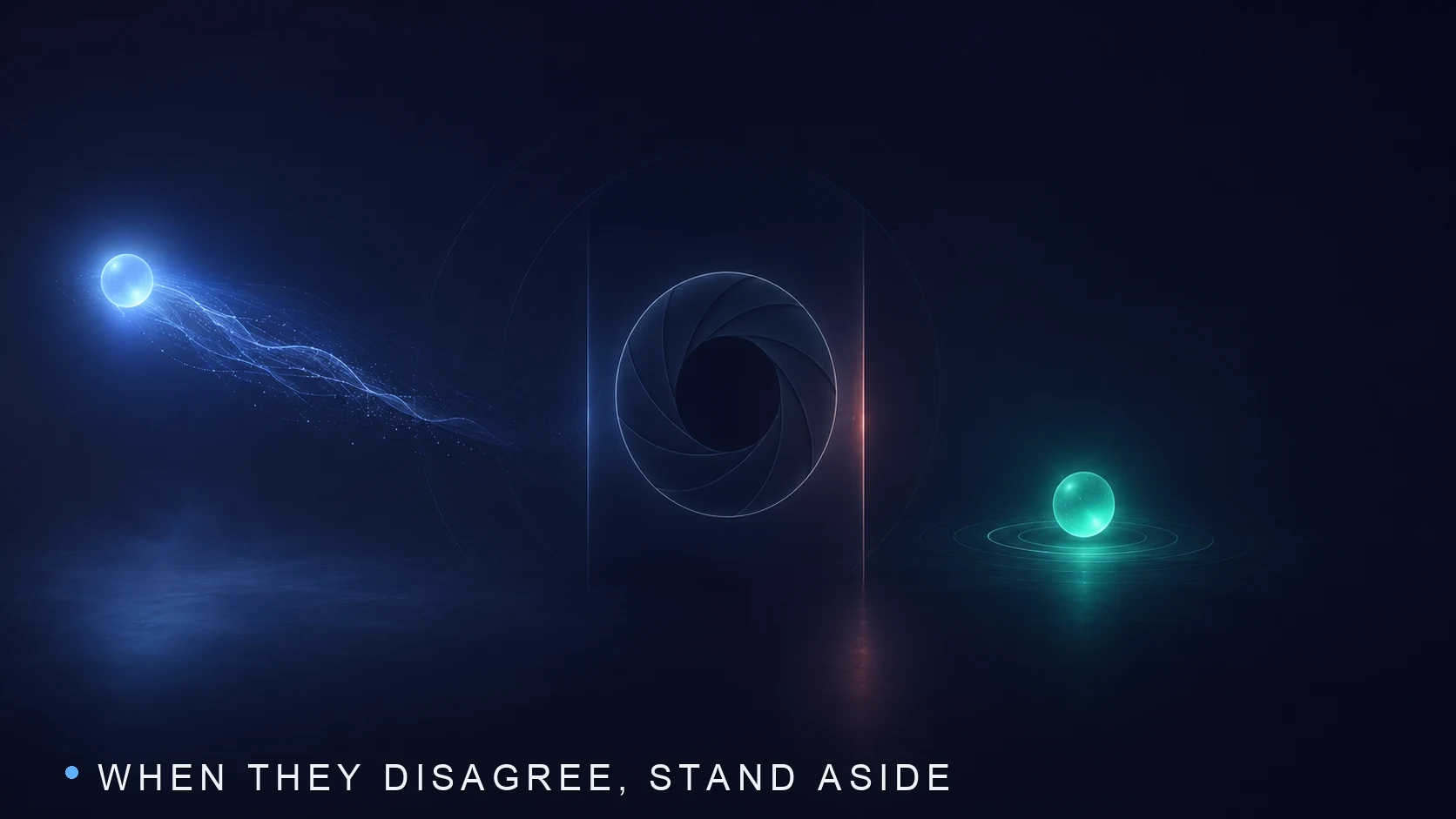
The conflict state: when the horizons disagree
The defining non-event for this archetype is horizon disagreement. When one horizon is stretched to an extreme while the other is not, the agreement gate is not satisfied and the method stands aside. A single-horizon extreme is read as unconfirmed positioning rather than a directional call, so disagreement produces no trade rather than a hedged or half-sized one. Standing aside in the conflict state is a decision the method makes on purpose, not a gap in its coverage.
When it stands aside, and where it can fail
Because both horizons must agree at an extreme, the method is flat far more often than it is in a trade, and that selectivity is the point rather than a flaw. Its honest failure shapes follow from the same design. A market whose positioning stays pinned at one extreme for a long stretch makes every reading look extreme for itself, which can keep the gate open through a move that has already played out. Because exit needs only one horizon to relax, a single fast-moving horizon can flush the method out of an otherwise aligned position. A structural shift in how much open interest normally sits on each side re-bases the history the rank depends on. And the agreement gate raises the bar for entry without guaranteeing direction: both horizons can concur at an extreme and the move can still go the other way, which is what the protective stop is there for.
How to read it on the dashboard
How it is validated

Walk-forward verification trains the rule on an older slice of history and asks it to reproduce an unseen later slice, then compares its calls with what the market actually did. A close match means the signal pattern reproduced on unseen data, with the calls matching the expected replay contract, not that it made money and not a claim about future direction. The result is scored against a fixed acceptance panel, and a model built this way may clear only part of it, so its evidence is partial and a backtest is not a record of live performance. The gates it does not clear are shown openly, because they are the risk story rather than a footnote.
What this archetype is not
- Not a price or candle read: its evidence is the balance of options open interest, not the price tape, the closes, or the order book.
- Not the put-skew method: that reads how richly the options market prices downside protection, a price-of-protection and implied-volatility read. This reads the quantity of standing positioning, where open interest sits across puts and calls, which is a different thing entirely.
- Not a single-input ranked-regime read: the percentile-regime family ranks one market-state input against its own history. This requires two horizons of the put-versus-call balance to agree at the same extreme before it acts.
- Not a z-score-and-condition gate: that family standardizes a primary read with a mean-and-spread z-score and gates it with a separate confirming condition. This ranks the same positioning quantity at two horizons and requires their agreement.
- Not a volatility-surface read: it never looks at the level, shape, or term structure of implied volatility; it looks only at where open interest is balanced across puts and calls.
- Not tied to one instrument: the method is a fixed family identity independent of which market it reads.
Reusable across instruments
What makes this an archetype rather than a single trade is that it is defined by how it reads, the balance of options open interest across two horizons, not by which market it reads. Point the same method at a different instrument and the recipe is unchanged: rank the put-versus-call balance at a near and a medium horizon against each horizon's own recent history, require both to reach a shared extreme before acting, mirror the long and short conditions, and manage the position with a hysteresis exit and a pre-set holding rulebook. The documented model is one instantiation of that template, and its regime orientation and holding horizon are read from its own behavior, not inherited from the family.
Specific models built on this archetype, with their benchmarks, are listed in the catalog. The archetype itself is a method, not any one of those models.
This explainer describes a method, not a recommendation, and a model built this way is not a guarantee of future results. It is a disciplined way of reading where the options crowd is positioned across two horizons, and acting only when both horizons lean the same way clearly enough to be worth it.
Sources
This article is based on Stonewell One research, including backtesting, walk-forward verification, deployment monitoring, and model-risk review.